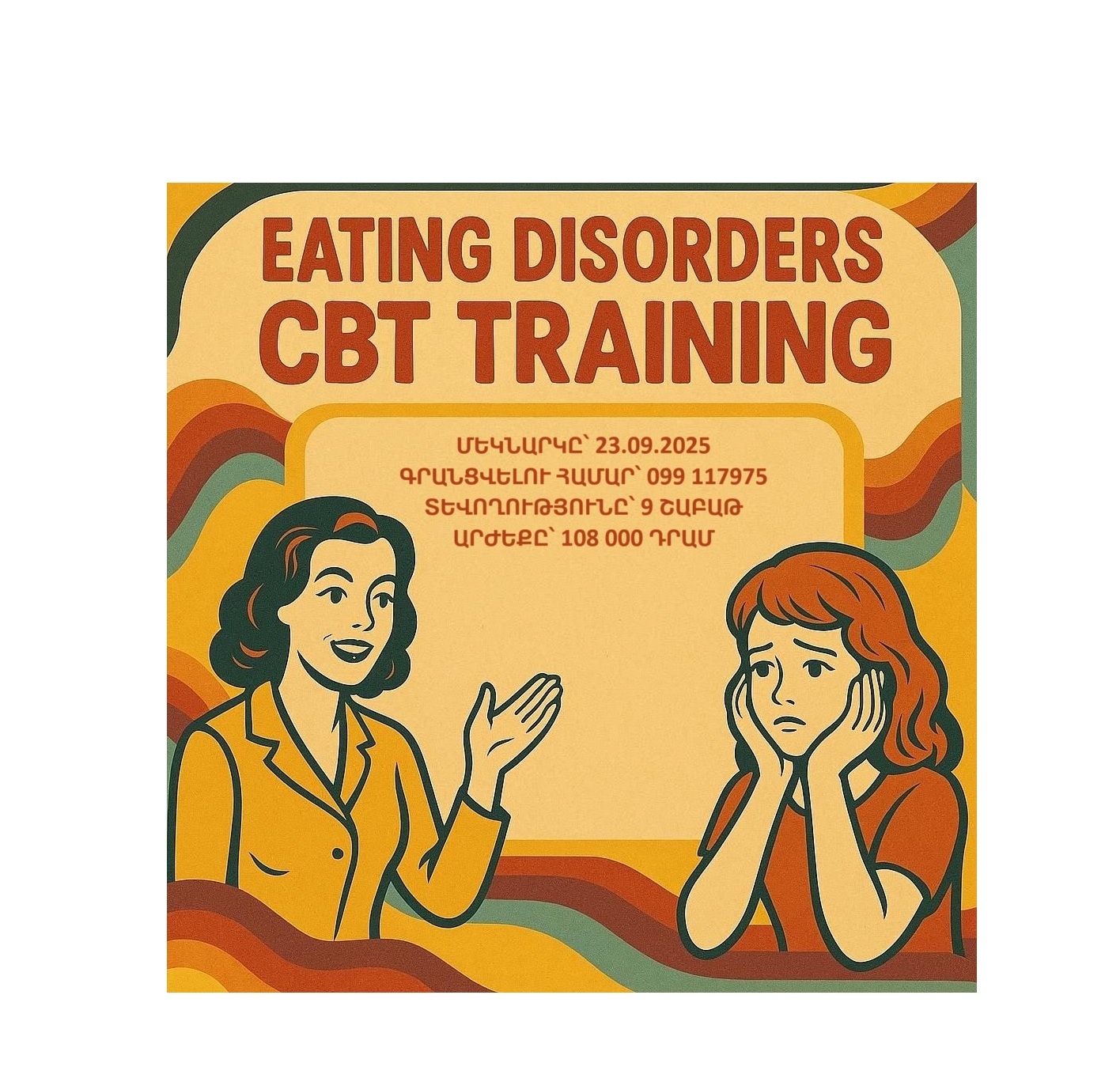
Armenian Mental Health Association, in collaboration with the Behavioral Society, is conducting a training course on “Working with Eating Disorders”.
The course will be held from September 30 to November 27.
Program:
Lesson 1
· What is an eating disorder: diagnosis, criteria, symptom manifestations
· Diagnosis: how to understand if a visitor has an eating disorder
· Criteria for eating disorders, clinical and non-clinical forms of eating disorders / comparison of ICD-10, ICD-11 and DSM-5 classifiers
· Comorbid disorders
· Hospitalization: in which cases is it indicated, criteria
· Teamwork: Professional responsibilities. Psychiatrist, nutritionist, endocrinologist and other doctors. When are they recommended, how to form your team
Lesson 2
· A modern, transdiagnostic approach to the problem of eating disorders
· How to work with eating disorders, the basics of clinical interview
· Building a CBT concept, joint development of a therapy plan
Lesson 3
Practical exercises: collecting anamnesis, developing a concept and therapy plan
Lesson 4
· Working with client motivation, the 1st stage of therapy
· Motivational interviewing and psychoeducation on eating disorder therapy, how to build the client's motivation
· Development of basic skills in eating disorder therapy
· Involving family members - when is it indicated? How to work with the client's family and social circle.
Lesson 5
· Therapy stages, working with food beliefs
· Identifying and understanding core food beliefs
· Work sequence and key tools
Lesson 5, Lesson 6
· Therapy stages: working with body image
· Defining and conceptualizing negative body image
· Therapy sequence, key tools, and possible future perspectives
Lesson 7
· Therapy stages: working with the client’s emotions and mood
· Basic mood model
· Therapy sequence, key tools, and application skills
Lesson 8
· The process of completing eating disorder therapy, practical examples
· Key indications for completing therapy
· How long does therapy last? Features of inpatient and outpatient care, what is remission? How long may it take to achieve significant changes? Research, real cases, experience and discussions
· The therapist’s personality and the therapeutic alliance. How can personal experience or lack thereof with an eating disorder affect therapy? How and what beliefs and experiences will the therapist have in relation to the client? What personal processes should be included in supervision or personal therapy?
Lesson 9
Skill development, clinical case analysis, program completion
To register, call 099117975